Mapping linguistic epistemicity
(Vici NWO grant 2024-2029)
In a conversation, you give all sorts of extra information to the addressee through language, for example whether the message is surprising, how certain you are, or what the source of the information is. The MapLE project aims to chart how this extra information is organised in our minds, focusing on how African languages express the knowledge of the speaker and the addressee. This way, we can discover whether this organisation is the same for people or influenced by the language you speak
For more information, please visit the MapLE website.
Enhancing Linguistic Scholarship in Eastern Africa
(Una Europa Africa Partnership Seed Fund grant, 2024-2025 – co-applicants: Allen Asiimwe, Lotta Aunio, Saudah Namyalo, Bert Remijsen)
Of the approximately 7000 languages that are used in the world today, one third are endangered, and only about half have a proper description. Describing languages is important because it forms the foundation for school materials and books, for understanding cultural heritage and history, and to determine the typology of language structures. There is thus a large and urgent task, requiring good linguistic skills. The ELSEA project, funded by Una Europa, aims to enhance these skills through an online course and a field school.
Bantu Syntax and Information structure
(Vidi NWO grant 2017-2023)
The BaSIS project investigated the influence of information structure on nominal licensing in Bantu languages. The research diagnoses multiple aspects of information structure for ten Bantu languages to document how these are expressed in each language.
The new data contribute to a better understanding of the grammar of the individual languages, and reveal crosslinguistic patterns in the expression of information structure. With these new insights we aim to improve the existing syntactic model, specifically of nominal licensing, to better fit the Bantu languages and their variation.
For more information, please visit the BaSIS website.
Processing of focus in Makhuwa-Enahara – an EEG investigation
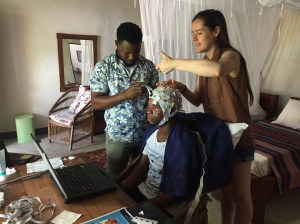
In a collaboration between LUCL and the Max Planck Institute in Nijmegen, we are investigating the processing of focus in Makhuwa-Enahara. Linguistic focus is thought to affect processing resources in our brain: when information is in focus, more neuro-cognitive resources are allotted to it. We investigated this using the N400 component as a marker, which typically appears in response to difficulties with integrating linguistic information, evident in semantic incongruencies like ‘The woman ate socks’. For example, Wang et al. (2009) showed that the N400 effect was more pronounced when an incongruency was in focus than when backgrounded. This was found for Mandarin and Dutch, but does it hold universally? Specifically, does focus have similar electrophysiological consequences when expressed morphosyntactically? To find out, we conducted an EEG experiment in a fieldwork setting in Mozambique with speakers of Makhuwa-Enahara where focus is expressed in the verbal inflection.

Using VR for linguistic fieldwork
(LUCDH small grant, 2022-2023)
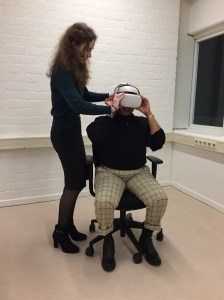
In this proof-of-concept project, together with Paz González we employed Virtual Reality (VR) technology for linguistic data collection. Traditional verbal and picture stimuli on paper are still quite restricted: we can never fully control what the speaker may be imagining in addition to the given stimulus. We can get much closer to a full and natural context if we present speakers with a 360° vivid environment; one in which the linguistic factors to be studied are carefully controlled. This is now possible thanks to VR technology. We piloted the technology by creating 360° virtual environments in 4 videos, and tested these with speakers of Spanish to study linguistic Aspect, and with speakers of Xitsonga/Xichangana to study Focus (what is highlighted information?) and Evidentiality (what is the source of the information?).
See also the description on the LUCDH website and the Leiden Language Blog.

 jenneke van der wal